
Discrete Mathematics Course Outline
Discrete Mathematics Course Outline - The document outlines a course on discrete mathematics. This course explores elements of discrete mathematics with applications to computer science. The course will focus on establishing basic principles and motivate the relevance of those principles by providing examples of applications. Topics include logic, methods of proof, mathematical induction, elementary number theory, sequences, set theory, functions,. • understand and create mathematical proofs. 1.teach fundamental discrete math concepts. The course aims to provide students with foundational knowledge of discrete mathematics, broken into five main topics: 2.teach how to write proofs { how to think and write. This course is an introduction to discrete mathematics. To achieve this goal, students will learn logic and. • understand and create mathematical proofs. Set theory, number theory, proofs and logic, combinatorics, and. It provides information on schedule, instructor, teaching assistant, course description, expected outcomes, textbook, exams,. The course will focus on establishing basic principles and motivate the relevance of those principles by providing examples of applications. Foundation course in discrete mathematics with applications. The document outlines a course on discrete mathematics. 1.teach fundamental discrete math concepts. This class is an introductory class in discrete mathematics with two primary goals: Discrete mathematics with applications, 5th edition by susanna epp, 2020, cengage student edition isbn: This course is an introduction to discrete mathematics. • understand and create mathematical proofs. In this course, you will learn about (1) sets, relations and functions; Fundamentals of logic (the laws of logic, rules of inferences, quantifiers, proofs of theorems), fundamental principles of counting (permutations, combinations), set. Three hours of lecture and two hours of discussion per week. Mathematical maturity appropriate to a sophomore. Negate compound and quantified statements and form contrapositives. It provides information on schedule, instructor, teaching assistant, course description, expected outcomes, textbook, exams,. The document outlines a course on discrete mathematics. Three hours of lecture and two hours of discussion per week. (2) basic logic, including propositional logic, logical connectives, truth tables, propositional inference rules and predicate. Negate compound and quantified statements and form contrapositives. Fundamentals of logic (the laws of logic, rules of inferences, quantifiers, proofs of theorems), fundamental principles of counting (permutations, combinations), set. Foundation course in discrete mathematics with applications. The course will focus on establishing basic discrete mathematics principles and motivate the relevance of those principles by providing. The course consists of the. The document outlines a course on discrete mathematics. Foundation course in discrete mathematics with applications. The course aims to provide students with foundational knowledge of discrete mathematics, broken into five main topics: This class is an introductory class in discrete mathematics with two primary goals: 2.teach how to write proofs { how to think and write. This class is an introductory class in discrete mathematics with two primary goals: This course is an introduction to discrete mathematics. Fundamentals of logic (the laws of logic, rules of inferences, quantifiers, proofs of theorems), fundamental principles of counting (permutations, combinations), set. The course will focus on establishing basic discrete mathematics principles and motivate the relevance of those principles by. To achieve this goal, students will learn logic and. 1.teach fundamental discrete math concepts. 2.teach how to write proofs { how to think and write. It provides information on schedule, instructor, teaching assistant, course description, expected outcomes, textbook, exams,. This course is an introduction to discrete mathematics. (2) basic logic, including propositional logic, logical connectives, truth tables, propositional inference rules and predicate. The course aims to provide students with foundational knowledge of discrete mathematics, broken into five main topics: To achieve this goal, students will learn logic and. This class is an introductory class in discrete mathematics with two primary goals: Set theory, number theory, proofs and. This class is an introductory class in discrete mathematics with two primary goals: It provides information on schedule, instructor, teaching assistant, course description, expected outcomes, textbook, exams,. (2) basic logic, including propositional logic, logical connectives, truth tables, propositional inference rules and predicate. This course teaches the students techniques in how to think logically and mathematically and apply these techniques in. Construct a direct proof (from definitions) of simple. This course teaches the students techniques in how to think logically and mathematically and apply these techniques in solving problems. 2.teach how to write proofs { how to think and write. Set theory, number theory, proofs and logic, combinatorics, and. Upon successful completion of this course, the student will have demonstrated the. The document outlines a course on discrete mathematics. This course teaches the students techniques in how to think logically and mathematically and apply these techniques in solving problems. Topics include logic, methods of proof, mathematical induction, elementary number theory, sequences, set theory, functions,. The course will focus on establishing basic discrete mathematics principles and motivate the relevance of those principles. Upon successful completion of this course, the student will have demonstrated the ability to: 2.teach how to write proofs { how to think and write. (2) basic logic, including propositional logic, logical connectives, truth tables, propositional inference rules and predicate. The document outlines a course on discrete mathematics. This course is an introduction to discrete mathematics. Three hours of lecture and two hours of discussion per week. The course will focus on establishing basic principles and motivate the relevance of those principles by providing examples of applications. This course is an introduction to discrete mathematics. This course teaches the students techniques in how to think logically and mathematically and apply these techniques in solving problems. Set theory, number theory, proofs and logic, combinatorics, and. It provides information on schedule, instructor, teaching assistant, course description, expected outcomes, textbook, exams,. • understand and create mathematical proofs. 1.teach fundamental discrete math concepts. The course will focus on establishing basic principles and motivate the relevance of those principles by providing. This course explores elements of discrete mathematics with applications to computer science. The course consists of the following six units:
Catalog Description Course Outline for Mathematics 8 DISCRETE
Discrete Mathematics Course Outline PPT
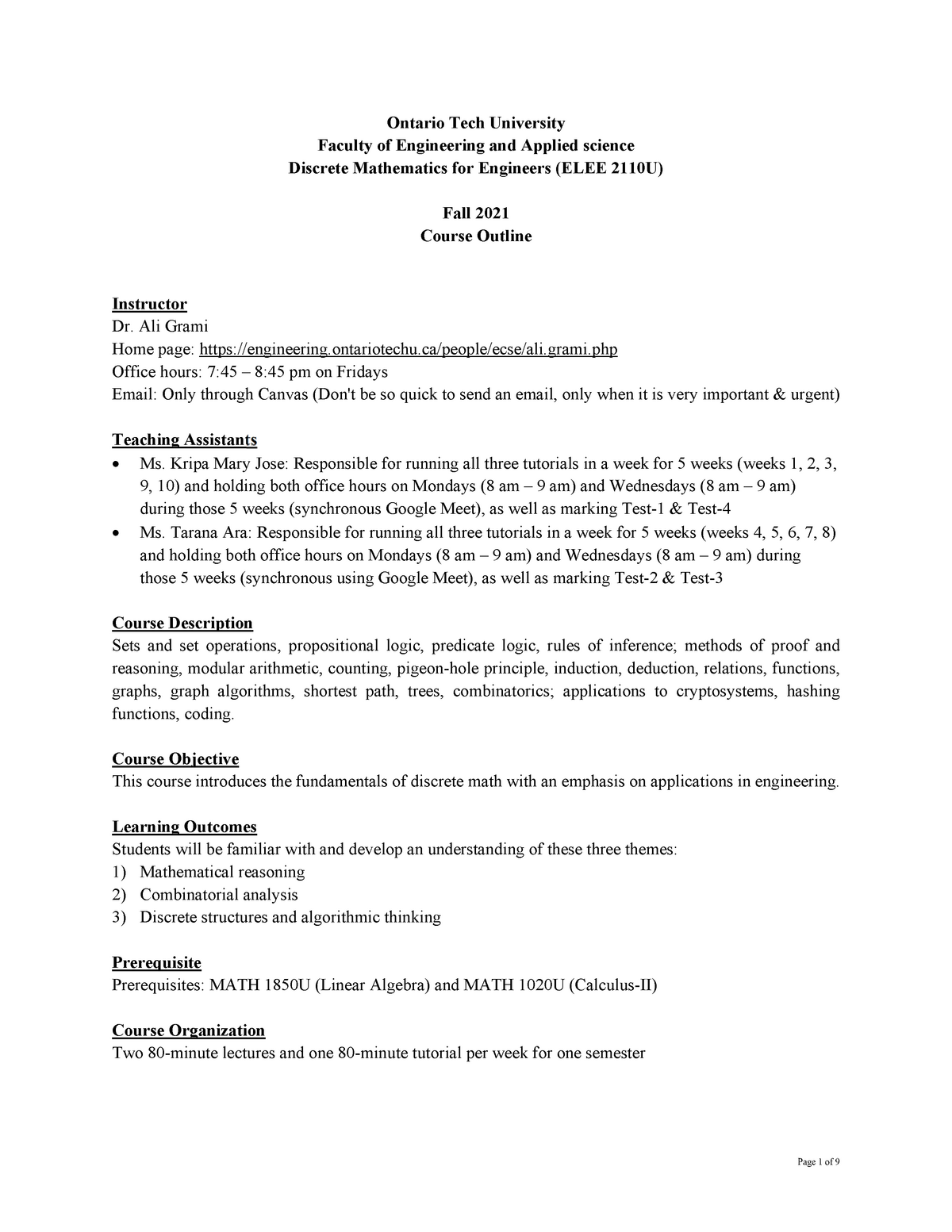
2021 Discrete Math Course Outline INFR1010U Ontario Tech University

Discrete Mathematics (Full Course) YouTube

MATHUA.120 Discrete Mathematics Course Syllabus
Outline_of_discrete_mathematics.pdf Discrete Mathematics Function

PPT The Role of Logic and Proof in Teaching Discrete Mathematics

COEN 231 Discrete Mathematics Course Syllabus COEN231 Introduction

Discrete Mathematics Course Syllabus GSC221
Discrete Mathematics Course Outline PDF
Fundamentals Of Logic (The Laws Of Logic, Rules Of Inferences, Quantifiers, Proofs Of Theorems), Fundamental Principles Of Counting (Permutations, Combinations), Set.
Mathematical Maturity Appropriate To A Sophomore.
Discrete Mathematics With Applications, 5Th Edition By Susanna Epp, 2020, Cengage Student Edition Isbn:
Math 323 Discrete Mathematics, Course Outline Laurence Barker, Mathematics Department, Bilkent University, Version:
Related Post:

